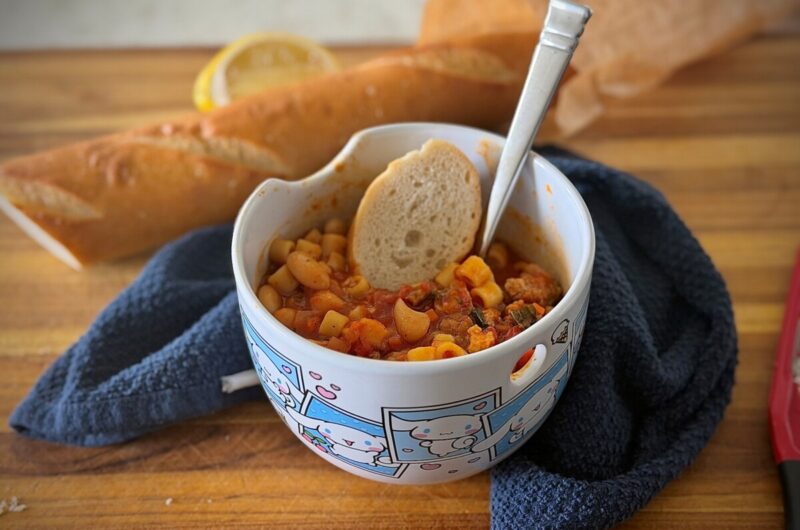
This Pasta e Fagioli with Italian Sausage is a hearty, comforting Italian soup loaded with savory sausage, tender cannellini beans, pasta, and vegetables in a rich tomato broth. Slowly simmered with fresh basil, Parmesan, and aromatic herbs, every spoonful is packed with flavor. A little Calabrian chile adds an optional spicy kick, while fresh kale brings everything together for a satisfying meal that’s perfect for cooler weather. Serve it with crusty bread and plenty of freshly grated Parmesan.
What Is Pasta e Fagioli?
Pasta e Fagioli, which translates to “pasta and beans” in Italian, is a traditional Italian dish that has been enjoyed for generations. It’s a simple, rustic meal built around two humble ingredients: pasta and beans.
Depending on the region and family recipe, Pasta e Fagioli can range from a thick, almost stew-like consistency to a brothy soup. Some versions use tomatoes, while others rely on beans, aromatics, and broth to create their flavor.
My version takes things a little further with Italian sausage, Calabrian chiles, fresh kale, and a Parmesan rind. The result is a rich, hearty soup with plenty of texture and a deep, savory flavor that develops as it simmers.
Start With the Italian Sausage
The first step to building a flavorful Pasta e Fagioli is properly browning the Italian sausage.
Instead of immediately breaking the sausage into small pieces, I like to spread it across the bottom of a hot pot and let it cook undisturbed until a deep golden-brown crust develops.
Once that crust forms, flip the sausage and begin breaking it into smaller pieces.
This technique gives the sausage more color and creates those delicious browned bits at the bottom of the pot.
Once the sausage is cooked, remove it and leave the rendered fat behind. That fat becomes the foundation for the rest of the soup, adding flavor to every ingredient that follows.
Build Flavor With the Vegetables
After removing the sausage, lower the heat and add the onion, carrots, and celery.
This combination is known as soffritto in Italian cooking, and it’s the foundation of countless soups, sauces, and braised dishes.
Cooking the vegetables slowly in the sausage drippings allows them to soften and release their natural sweetness.
Once they’re tender, add the garlic, Italian seasoning, and fennel seeds.
The fennel is especially good here because it complements the flavor of the Italian sausage and adds another layer of warmth to the broth.
Don’t Rush the Tomato Paste
One of my favorite ways to build depth in a tomato-based soup is to cook the tomato paste before adding any liquid.
Push the vegetables toward the edges of the pot to create an opening in the center. Add the tomato paste directly to the hot surface and let it cook until it darkens slightly.
As the tomato paste cooks, its flavor becomes richer and more concentrated.
Once it’s developed some color, mix it into the vegetables.
This is also when I like to add Calabrian chiles. They’re spicy, slightly fruity, and bring a bold chile flavor that works beautifully with the sausage and tomatoes.
They’re completely optional, but if you like a little heat, I definitely recommend them.
Deglaze With White Wine
After cooking the tomato paste and Calabrian chiles, add a splash of dry white wine.
The wine helps release all those flavorful browned bits stuck to the bottom of the pot while adding acidity that balances the richness of the sausage.
Let the wine simmer and reduce before adding the remaining ingredients.
As it reduces, the flavor becomes more concentrated and blends with the aromatics, tomato paste, and sausage drippings.
The Secret Is the Parmesan Rind
One ingredient that makes a huge difference in this soup is a Parmesan rind.
Instead of throwing away the hard end of a block of Parmigiano Reggiano, save it for soups like this.
As the rind slowly simmers in the broth, it releases savory, nutty flavors that give the soup incredible depth.
Combined with the crushed tomatoes, beef stock, Italian sausage, and fresh basil, it creates a broth that tastes like it’s been cooking all day.
Let everything simmer gently for about an hour so the flavors have time to develop.
Just remember to remove the rind before serving.
Cannellini Beans and Ditalini Pasta
The two ingredients that define Pasta e Fagioli are, of course, the pasta and beans.
I like using cannellini beans because they’re creamy, tender, and hold their shape well in the soup. Their mild flavor works perfectly with the rich tomato broth and savory sausage.
For the pasta, ditalini is a great choice.
These small, tube-shaped noodles are the perfect size for soup, making it easy to get a little pasta, beans, sausage, and broth in every spoonful.
I add both toward the end of cooking so the pasta doesn’t become overly soft during the long simmer.
Keep in mind that pasta will continue absorbing liquid as the soup sits, so you may need to add a splash of stock when reheating leftovers.
Finish With Kale and Fresh Citrus
Once the pasta is al dente, I like to add chopped kale and a squeeze of fresh lime juice.
The kale adds color, texture, and a slightly earthy flavor that balances the richness of the broth.
Let it simmer for another 10 minutes until the kale becomes tender.
The lime juice might not be a traditional addition, but I like how its acidity brightens the tomatoes and cuts through the richness of the sausage and Parmesan.
It’s a small finishing touch that makes the entire soup taste a little fresher.
Don’t Forget the Bread
A big bowl of Pasta e Fagioli deserves a piece of good crusty bread.
The broth is rich, savory, and full of flavor, and you’ll definitely want something to soak up every last bit.
I like serving mine with freshly grated Parmesan and a drizzle of good extra virgin olive oil.
The Parmesan adds another layer of salty, nutty flavor, while the olive oil gives the soup a silky finish.
The Ultimate Comfort Food
What I love most about Pasta e Fagioli with Italian Sausage is how a handful of simple ingredients can turn into something so flavorful.
Browning the sausage, slowly cooking the vegetables, caramelizing the tomato paste, and simmering everything with a Parmesan rind all contribute to the finished dish.
By the time the beans, pasta, and kale are added, you’ve built a rich, hearty soup that’s packed with layers of flavor.
It’s perfect for a Sunday dinner, meal prepping for the week, or anytime you want a big bowl of comfort food.
And like most soups, the flavors only get better the next day.
Just make sure you have plenty of crusty bread nearby.
Pasta e Fagioli with Italian Sausage
Course: mainCuisine: ItalianDifficulty: Easy4
servings30
minutes40
minutes300
kcalIngredients
2 tablespoons extra virgin olive oil, plus more for serving
1 lb Italian sausage, casings removed
1 medium yellow onion, diced
2 medium carrots, diced
2 celery stalks, diced
4 garlic cloves, minced
1 teaspoon Italian seasoning
½ teaspoon fennel seeds
2 tablespoons tomato paste
1–2 tablespoons chopped Calabrian chiles in oil (optional)
½ cup dry white wine
1 (28-ounce) can crushed tomatoes
1 cup water, for rinsing the tomato can
4 cups beef stock, plus more as needed
1 Parmesan rind
½ cup fresh basil leaves, torn
2 (15-ounce) cans cannellini beans, drained and rinsed
1 cup dry ditalini pasta
2 cups chopped kale, tough stems removed
Juice of ½ lemon
Kosher salt, to taste
Freshly ground black pepper, to taste
- For serving
Freshly grated Parmesan cheese
Extra virgin olive oil
Crusty bread
Directions
- Brown the Italian sausage. Heat the extra virgin olive oil in a large Dutch oven or heavy-bottomed pot over medium-high heat.
Add the Italian sausage and spread it evenly across the bottom of the pot, pressing it down into a single layer.
Allow the sausage to cook undisturbed until a deep golden-brown crust forms on the bottom, about 4–5 minutes.
Flip the sausage, then begin breaking it into smaller pieces with a wooden spoon. Continue cooking until browned and fully cooked through.
Remove the sausage from the pot and set aside, leaving the rendered fat and oil behind. - Sauté the vegetables. Reduce the heat to medium.
Add the diced onion, carrots, and celery to the pot. Sauté for approximately 6–8 minutes, stirring occasionally, until the vegetables begin to soften.
Season with salt and freshly ground black pepper. - Add the aromatics. Stir in the minced garlic and cook for about 30 seconds until fragrant.
Add the Italian seasoning and fennel seeds, stirring to combine. - Cook the tomato paste. Push the vegetables toward the edges of the pot to create an opening in the center.
Add the tomato paste directly to the bottom of the pot and cook for 2–3 minutes, stirring occasionally, until it darkens to a deeper red color.
Mix the tomato paste into the vegetables until everything is evenly coated. - Add the Calabrian chiles. Stir in the chopped Calabrian chiles, if using, and cook for another 30–60 seconds to release their flavor into the oil.
- Deglaze with white wine. Pour in the white wine, scraping the bottom of the pot with a wooden spoon to release any browned bits.
Allow the wine to simmer and reduce for approximately 3–4 minutes, until the liquid has reduced significantly. - Build the soup. Add the crushed tomatoes to the pot.
Pour 1 cup of water into the empty tomato can, swirl it around to collect any remaining tomatoes, and pour it into the pot.
Add the beef stock and return the browned Italian sausage to the pot.
Tear the fresh basil leaves and add them to the soup along with the Parmesan rind.
Stir everything together until well combined. - Simmer the soup. Bring the soup to a gentle simmer, then reduce the heat to low.
Cover the pot and cook for 1 hour, stirring occasionally to prevent anything from sticking to the bottom.
The broth should develop a rich, savory flavor as the sausage, tomatoes, herbs, and Parmesan rind simmer together. - Add the beans and pasta. After 1 hour, remove the lid and stir in the drained cannellini beans and dry ditalini pasta.
Continue simmering, stirring occasionally, until the pasta is al dente, approximately 8–10 minutes or according to the package instructions.
Add a splash of additional beef stock or water if the soup becomes too thick. - Add the kale and lemon. Stir in the chopped kale and squeeze in the juice of half a lemon.
Continue cooking for another 10 minutes, or until the kale is tender and the pasta is fully cooked.
Taste the soup and adjust the salt and black pepper as needed.
Remove and discard the Parmesan rind. - Serve. Ladle the Pasta e Fagioli into serving bowls.
Finish with a generous amount of freshly grated Parmesan cheese and a drizzle of extra virgin olive oil.
Serve immediately with warm, crusty bread.
Tips for the Best Pasta e Fagioli
Get a good sear on the sausage. Pressing the sausage into the pot and allowing a crust to form before breaking it apart creates more flavor than immediately crumbling it.
Cook the tomato paste. Allowing the tomato paste to darken slightly before adding liquid helps develop a richer tomato flavor.
Save your Parmesan rinds. Keep leftover Parmesan rinds in the freezer so you always have one ready for soups, stews, and sauces.
Adjust the spice level. Calabrian chiles add a delicious spicy kick, but they’re optional. Start with a small amount and add more depending on your preference.
Watch the pasta. Ditalini will continue absorbing broth as it sits. If you prefer a brothier soup or plan to store leftovers, add more beef stock as needed. You can also cook the pasta separately and add it to individual bowls.
Don’t skip the lime. A squeeze of fresh lime at the end brightens the rich tomato broth and balances the sausage and Parmesan.
Make it ahead. The soup base can be prepared a day in advance. For the best texture, add the beans, pasta, and kale when you’re ready to finish and serve the soup.