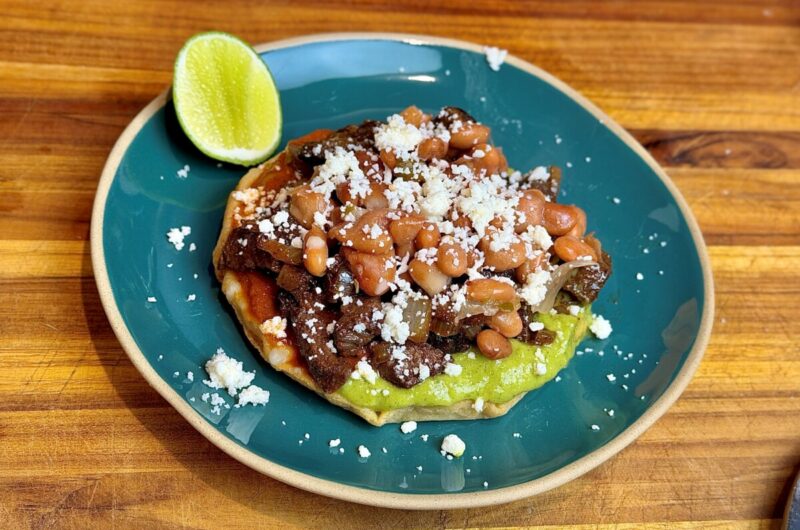
These Sopes con Carne are made with thick, handmade corn masa bases cooked until golden and slightly crispy, then loaded with layers of bold Mexican flavors. Each sope starts with melted cheese, followed by a combination of salsa verde and salsa roja divided across each half. Juicy, seasoned beef is piled on top, followed by tender whole beans and crumbled queso fresco. Every bite brings together smoky, savory, spicy, and creamy flavors with the perfect combination of textures.
What Are Sopes?
Sopes are a traditional Mexican dish made from corn masa that’s shaped into small, thick tortillas with raised edges. Unlike regular tortillas, sopes have a thicker base that holds up to a generous amount of toppings.
The raised edges are what make them unique. After the masa is partially cooked on a hot comal, the edges are pinched upward to create a small rim around the outside.
This creates the perfect little base for layering on all kinds of ingredients.
Sopes are popular throughout Mexico, and there are countless ways to prepare them. Some are topped with shredded chicken, chorizo, or beans, while others feature grilled meats and different salsas.
For this version, I’m combining melted cheese, two different salsas, seasoned beef, whole beans, and queso fresco for a sope that’s loaded with flavor.
It All Starts With the Masa
A good sope begins with properly prepared masa.
Fresh corn masa is ideal, but masa harina works just as well when making these at home.
The dough should be soft, smooth, and pliable without sticking to your hands. If it’s too dry, the edges will crack when you try to shape them. If it’s too wet, the dough will be difficult to work with.
Once the masa is ready, divide it into small balls and press them into thick tortillas, about ¼ inch thick.
You want them thicker than regular tortillas so they can support all the toppings without falling apart.
Creating the Perfect Sope
One of the most important steps is forming the signature raised edges.
Start by cooking the masa discs on a hot comal until they’re lightly cooked on both sides but still soft enough to shape.
While they’re still warm, carefully pinch the edges upward to form a small rim around the outside.
Once shaped, return them to the comal or lightly fry them until the bottoms develop a golden, crispy exterior.
The finished sope should have a slightly crunchy outside while remaining soft and tender inside.
Start With Melted Cheese
Instead of starting with the traditional layer of refried beans, these sopes begin with melted cheese.
I like using a good melting cheese, such as Oaxaca or Chihuahua, because it becomes perfectly gooey and adds a rich, creamy base.
While the sope is still hot, add a generous layer of cheese and let it melt across the surface.
This creates a delicious foundation for the rest of the toppings and adds a little richness to every bite.
Two Salsas Are Better Than One
One of my favorite parts of these sopes is using both salsa verde and salsa roja.
Instead of mixing them together, I divide the sope in half, spreading salsa verde across one side and salsa roja across the other.
The salsa verde brings a bright, tangy flavor, while the salsa roja adds a deeper, smoky chile flavor.
Keeping them separated gives each side a slightly different taste, and when the flavors meet in the middle, you get the best of both worlds.
It also makes for a beautiful presentation with the contrasting red and green colors.
Add the Beef
Once the cheese and salsas are in place, it’s time for the beef.
You want meat that’s well seasoned, juicy, and packed with flavor.
Cook the beef over high heat until it develops a beautiful crust, then mix in some sautéed onions.
Pile the beef generously over the salsas, making sure you get a little meat on both sides.
Whole Beans Instead of Refried
Rather than spreading refried beans on the bottom, I like adding whole cooked beans over the beef.
They bring a completely different texture to the sopes.
The beans should be tender and well seasoned but still hold their shape. Pinto beans work especially well, although you could use black beans if you prefer.
Drain off most of the cooking liquid before adding them so the sopes don’t become soggy.
The whole beans add a hearty, earthy flavor that balances the richness of the cheese and beef.
Finish With Queso Fresco
The final touch is a generous sprinkle of crumbled queso fresco.
Unlike the melted cheese underneath, queso fresco stays soft and crumbly, giving the sopes another layer of texture.
Its mild, slightly salty flavor balances the heat from the salsas without overpowering the other ingredients.
Between the melted cheese on the bottom and the queso fresco on top, you get two completely different cheese textures in every bite.
Bringing Everything Together
The key to these sopes is building the layers in the right order.
Start with a freshly cooked sope and melt the cheese directly onto the warm masa.
Next, add salsa verde to one half and salsa roja to the other, keeping the two sides separate.
Pile the juicy beef over the salsas, spoon on the tender whole beans, and finish everything with crumbled queso fresco.
Serve them immediately while the masa is still warm, the cheese is melted, and the beef is juicy.
A Different Take on a Mexican Classic
What makes these Sopes con Carne so good is the combination of flavors and textures.
You have the thick, slightly crispy corn masa, rich melted cheese, two completely different salsas, smoky beef, tender whole beans, and fresh queso fresco.
Every layer brings something different to the dish.
And with the salsa verde on one side and salsa roja on the other, you get a little variety in every bite.
These are the kind of sopes that don’t need a dozen extra toppings. Everything you need is already layered right on top.
Make them fresh, load them up, and serve them while they’re hot.
Sopes con Carne
Course: MainCuisine: MexicanDifficulty: Intermediate4
servings30
minutes40
minutes300
kcalIngredients
- For the beef
2 lbs sirloin or ribeye, cut into 1/2 inch cubes
1 tsp cumin
1 tsp onion powder
1 tsp garlic powder
1 tsp smoked paprika
1 tsp salt
1 white onion, diced
2 tbsp lard
- For the beans
1 lb dry pinto beans, rinsed
1/4 white onion
1 garlic clove
1 jalapeno, stem removed
2 tsp salt
6 cups water
- For the Salsa Verde
6 tomatillos, husked and washed
1 garlic clove
1/4 white onion
1 jalapeno, stem removed
1 tsp oregano
1/4 cup fresh cilantro
1/2 tsp salt
1 tsp Knorr chicken bouillon
1 avocado
- For the Salsa Roja
3 Roma tomatoes sliced in half
1/4 white onion
2 garlic cloves, skin still on
1 3.5 oz can chipotles in adobo
juice from half a lime
1/2 tsp salt
- For the Sopes
2 cups masa
1/2 tsp salt
2 cups warm water
Vegetable oil for frying
- For serving
Monterey Jack cheese, shredded
Queso fresco
lime
Directions
- Make the beans
- To a pressure cooker, add the beans, water, onion, jalapeno, and garlic. Cook on high pressure for 50 minutes and let the steam naturally release. Add the salt and taste.
- Make the salsa verde
- While the beans are cooking, make the two salsas. Add the tomatillos, jalapeno, and onion to a sauce pan and fill with water. Bring to a simmer and cook for 5 minutes. Cut the heat and let steep for 10 minutes.
- Remove the tomatillos, jalapeno, and onion from the sauce pan and add to a blender along with the salt, cilantro, garlic, oregano, Knor chicken bouillon, and avocado. Blend until smooth. If too thick, add water a tablespoon at a time. Taste for salt.
- Make the Salsa Roja
- Add the Roma tomatoes, white onion, and garlic to a baking tray. Place under the broiler on high heat and broil until charred. About 5 minutes per side. Keep an eye on the garlic because it tends to burn quick. If it starts to burn, remove it and continue cooking the other ingredients.
- Once charred, peel the garlic, and add everything to a blender along with the salt, chipotles, and lime. Blend until smooth. Taste for salt.
- Cook the steak
- To a bowl, add the salt, onion powder, garlic powder, smoked paprika, and cumin. Mix to combine. Add the steak to a large bowl and season with the spice mixture. Toss until fully coated.
- Preheat a large skillet over high and add in the lard. Once the pan starts to smoke, add in the seasoned beef. Spread evenly in the pan and let cook until a crust starts to form. About 3 minutes. Flip the beef using a wooden spoon and continue to cook until done. About 5 minutes. Remove to a bowl and reduce the heat to medium.
- Add the onion to the same skillet the beef was cooked in. Sauté until soft and translucent. About 7 minutes. Mix back in the beef. Squeeze over half a lime. Cut the heat and cover to keep warm until ready to serve.
- Make the Sopes
- Add the masa, salt, and water to a large mixing bowl and kneed for 3 minutes until a dough forms. The dough should be soft, smooth, and pliable without sticking to your hands. If it’s too dry, the edges will crack when you try to shape them. If it’s too wet, the dough will be difficult to work with. Once the masa is ready, divide it into small balls and press them into thick tortillas, about ¼ inch thick. You want them thicker than regular tortillas so they can support all the toppings without falling apart.
- Start by cooking the masa discs on a hot comal until they’re lightly cooked on both sides but still soft enough to shape. While they’re still warm, carefully pinch the edges upward to form a small rim around the outside.
Once shaped, lightly fry them in oil until the bottoms develop a golden, crispy exterior. The finished sope should have a slightly crunchy outside while remaining soft and tender inside. - Place the fried sopes on a wire rack to drain and immediately add a layer of the shredded cheese so it gets nice and melty from the residual heat.
- Serve
- Add the salsas dividing the sope in half, spreading salsa verde across one side and salsa roja across the other. Keeping them separated gives each side a slightly different taste, and when the flavors meet in the middle, you get the best of both worlds. It also makes for a beautiful presentation with the contrasting red and green colors.
- Pile the beef generously over the salsas, making sure you get a little meat on both sides. Add a spoonful of beans over the beef. Drain off most of the cooking liquid before adding them so the sopes don’t become soggy. Top with salsa fresca and a squeeze of lime. Hope you enjoy!